

Hey Rewire Collective!
Welcome to this week's newsletter! We’re talking about different types of dissociative experiences and what in the brain is going on during them.
What is Dissociation?
Dissociation is defined as disconnection between thoughts, feelings, behaviors, sensations, and other mental processes that would normally be connected. Cool, but what does that look like?
Symptoms include experiences like dissociative flashbacks (so intrusions to our awareness), dissociative amnesia (so no longer being able to control certain mental functions), and a sense of disconnectedness, or distorted perceptions of ourselves in our environments (depersonalisation, derealisation; 1,2).
If you can’t relate to any of these feelings, don’t panic, only 2-10% of the population will experience dissociation in their lifetime (3). And, nearly 75% of those instances follow a traumatic event (3).
Which brings us to the first question – is dissociation always bad?
Is dissociation always bad?
Dissociation is a common symptom of stress, and therefore is a hallmark of different trauma- and stress-related disorders, like borderline personality disorder (BPD), posttraumatic stress disorder (PTSD), and dissociative identity disorder (2).
Whether dissociation can occur in a ‘normal’ and ‘healthy’ way is debated (4). Early studies classify dissociation as ‘pathological’ (bad) or ‘non-pathological’ (okay) and say that ‘non-pathological’ dissociation can occur in healthy populations (5). Recent studies debate whether ‘non-pathological’ dissociation is actually not pathological, whether it does cause harm, and what we consider dissociation (4).
I think a continuum of dissociation is a helpful description, where we can think of things like daydreaming, ‘highway hypnosis’, or workflow on one end (6,7,8). On the other end, we have more serious dissociative experiences, which are most commonly linked to trauma (9). Research into both ends of dissociative experience suggests that different brain regions and circuits are involved in the different levels of dissociation.
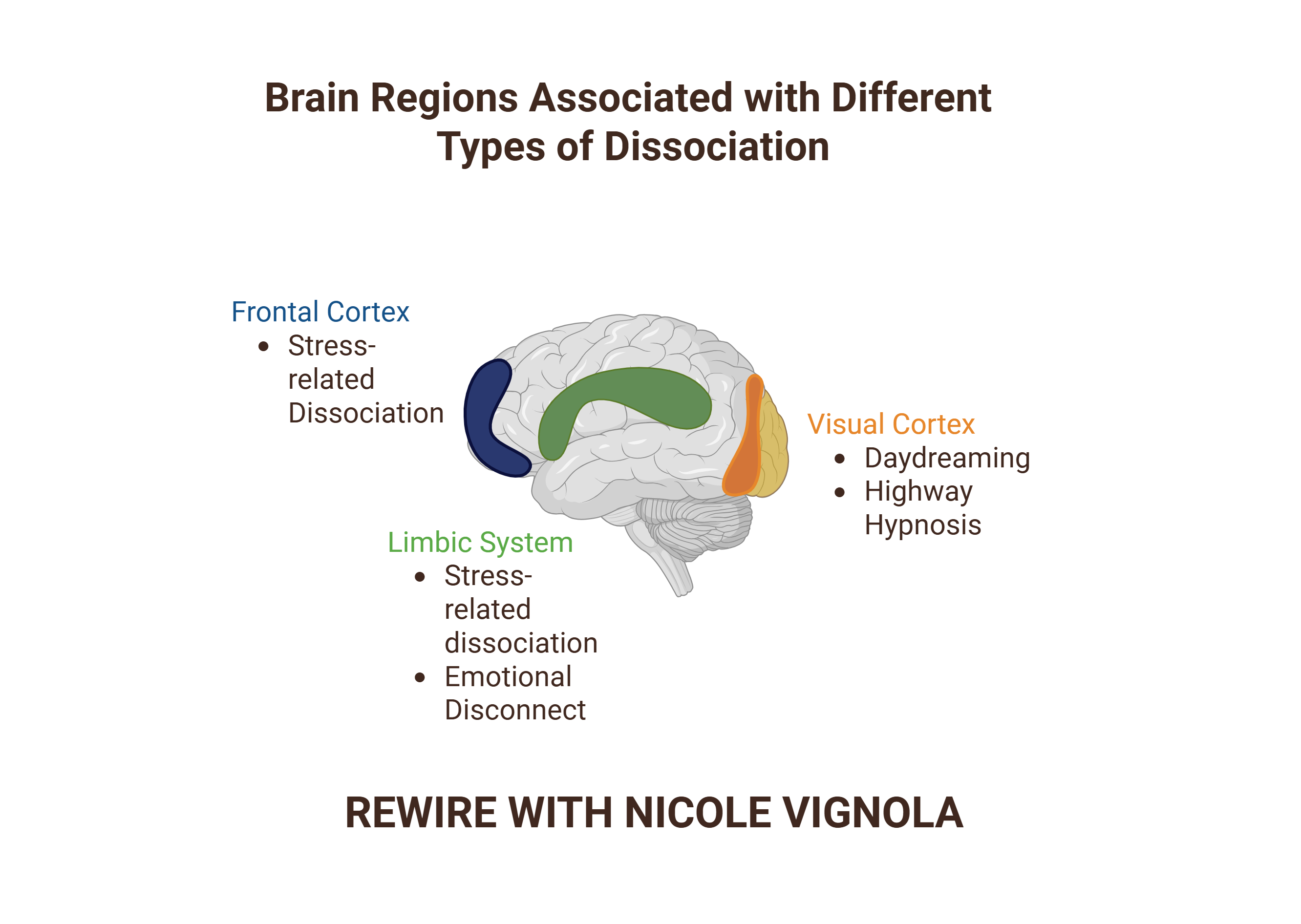
Daydreaming and Highway Hypnosis
Research shows that during both daydreaming and highway hypnosis, our visual cortices are highly activated (10, 11). Highway hypnosis appears to be more correlated to our eye movements and oculomotor system, as well as fatigue (11). Meanwhile, daydreaming shows brain activity occurring between the visual cortex and the hippocampus (in charge of memories) (10). In fact, this connectivity appears to be crucial for learning and memory. Plus, our default mode network (think frontal cortex and temporal cortex) is active during daydreaming, which helps us process information automatically (12). In this sense, the ‘dissociation’ we see on this end of the spectrum is functional.
Stress-Related Dissociation
The more studied side of dissociation is associated with trauma and dysfunction. This type of dissociation negatively impacts people’s ability to live their day-to-day lives (2). For example, someone may have an ‘out-of-body’ experience (depersonalisation) during a traumatic event. This is the body’s way of coping with the experience. However, the body then begins to associate this response to stress as the only way to respond. And this becomes more pronounced the more trauma occurs. Ultimately, this disrupts our ability to integrate information from our consciousness, emotions, identity, motor control, perceptions – all the things that form ‘you’.
Dissociation is a common symptom of trauma-related disorders like PTSD and BDP. Therefore, these are the contexts in which dissociation has often been studied. Here, we see that there is overregulation of limbic reactivity by the medial prefrontal cortex, meaning our emotional responses become disconnected from our rational thought processes (13). This is one brain circuit responsible for dissociative symptoms.
We also see dissociative ‘auras’ which occur before seizures. During these dissociative experiences, brain rhythms are different (14). A very distinct pattern of cortical brain activity is seen during dissociative experiences. Additionally, one particular protein, which we will call HCN1, is responsible for this rhythm in the cortex (14). Without it, the dissociation doesn’t occur.
So, what can we do?
For starters, if you experience any of these symptoms, don’t feel alone! And remember it’s not you, it’s your brain. If you feel like you’re experiencing these and they’re causing issues, reach out to a medical professional for help!
If you’re here because you’re interested, then know how important emotional regulation is for our brain to function.
The limbic system, our alert and react system, is a key player in many of these symptoms. Mindfulness activities can be a great way to calm her down.
Also, our eyes are key to a lot of our functioning, as we see in highway hypnosis and daydreaming. Getting out into nature and looking around is calming for our nervous system.
Until Next Week,
Nicole x
P.S. Leave a comment with requests for future newsletters!
References