
Your brain is limitless - program it correctly.

Hey Currency Collective!
Welcome to this week’s newsletter. I’ll be introducing the mathematical concept of combinatorial explosion - but have no fear, these mathematics take us back to the unlimited power of the brain.
Our Capacity for Learning
The way in which the human brain processes and combines information means that, despite its finite physical structure, is functionally limitless. Every thought or action creates the potential for new neural connections, leading to exponential possibilities for creativity, learning, and growth.
Let’s go back to basics for a moment. Our brains are made of two main types of cells: the neuron, which is responsible for sending signals throughout the brain, and glial cells, which are responsible for supporting neurons and maintaining brain health. Here’s a nice diagram of a neuron:

Neurons generally contain a cell body, where they receive signals from other cells, an axon, which they use to transport signals electrically, and the axon terminals, where they release chemicals to send the signal to another cell. Myelin is a substance covering the axon which acts as an electrical insulator, allowing signals to run from the cell body to the axon terminals quickly.
Synapses are the areas where one neuron’s axon terminals meet another neuron’s cell body to release chemical signals and allow for communication. Check out the below diagram3.
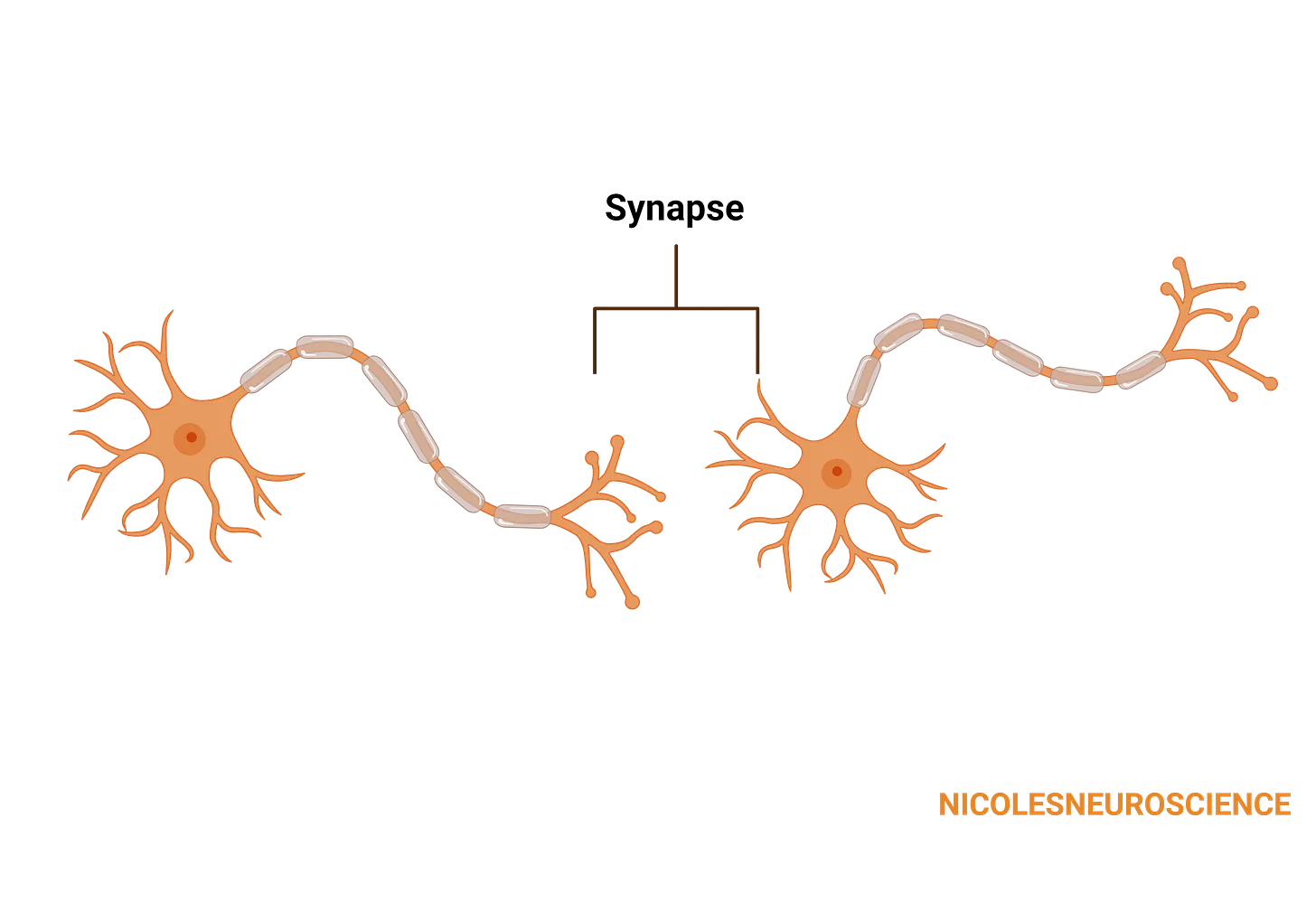
Babies are born with 100 billion neurons, on average1. Until they reach the age of 2, they continue growing new neurons and creating new synapses2. By age 2, they have more neurons and synapses than they need2. Thus, the process of removing unnecessary neurons and synapses begins. This is known as synaptic pruning, and continues until age 10.2 This still leaves the adult brain with an average of 86 billion neurons, and even more synapses (somewhere between 100 trillion and 500 trillion!).
When we think about the brain’s capacity for learning, I want to help you visualise just how limitless it truly is. To do that, I need to show you how combinatorial explosions in mathematics work.
Combinatorial Explosion
A combinatorial explosion is a phenomenon where the number of possible combinations grows rapidly as the number of inputs increases steadily4. Why?
Well, because each input being added can be combined with other inputs, each new input with two states doubles the total combinations:
For example, 10 light switches create 2¹⁰ (1,024) states, while 100 switches create a number larger than the atoms in the known universe.
This growth is so rapid that it quickly exceeds anything we can intuitively grasp.
Let me give an example:
Let’s take a deck of cards which has 52 cards in it:
With 1 card, there is only 1 arrangement,
With 2 cards, there are 2 arrangements.
3 cards result in 6 arrangements,
4 cards lead to 24 arrangements
5 cards allow for 120 unique arrangements!
By the time we reach all 52 cards in a deck, the total number of arrangements skyrockets to an incomprehensible figure of approximately 8.0658×1067. The complexity increases rapidly, even when we just add one single card.
Hence, a combinatorial explosion. The number has exploded into something so vast. If this seems confusing and incomprehensible, well done, that was sort of the point!
Bringing it back to brains
Our conscious mind may struggle to compute the immensity of that number, but the way our brain holds and communicates information through neurons and synapses, means that we can hold a much bigger amount of information!
We have trillions of connections in the brain - remember those 100-500 trillion synapses I mentioned - so the possible number of combinations is practically limitless. These possible combinations and connections underlie all of our learning and memory!
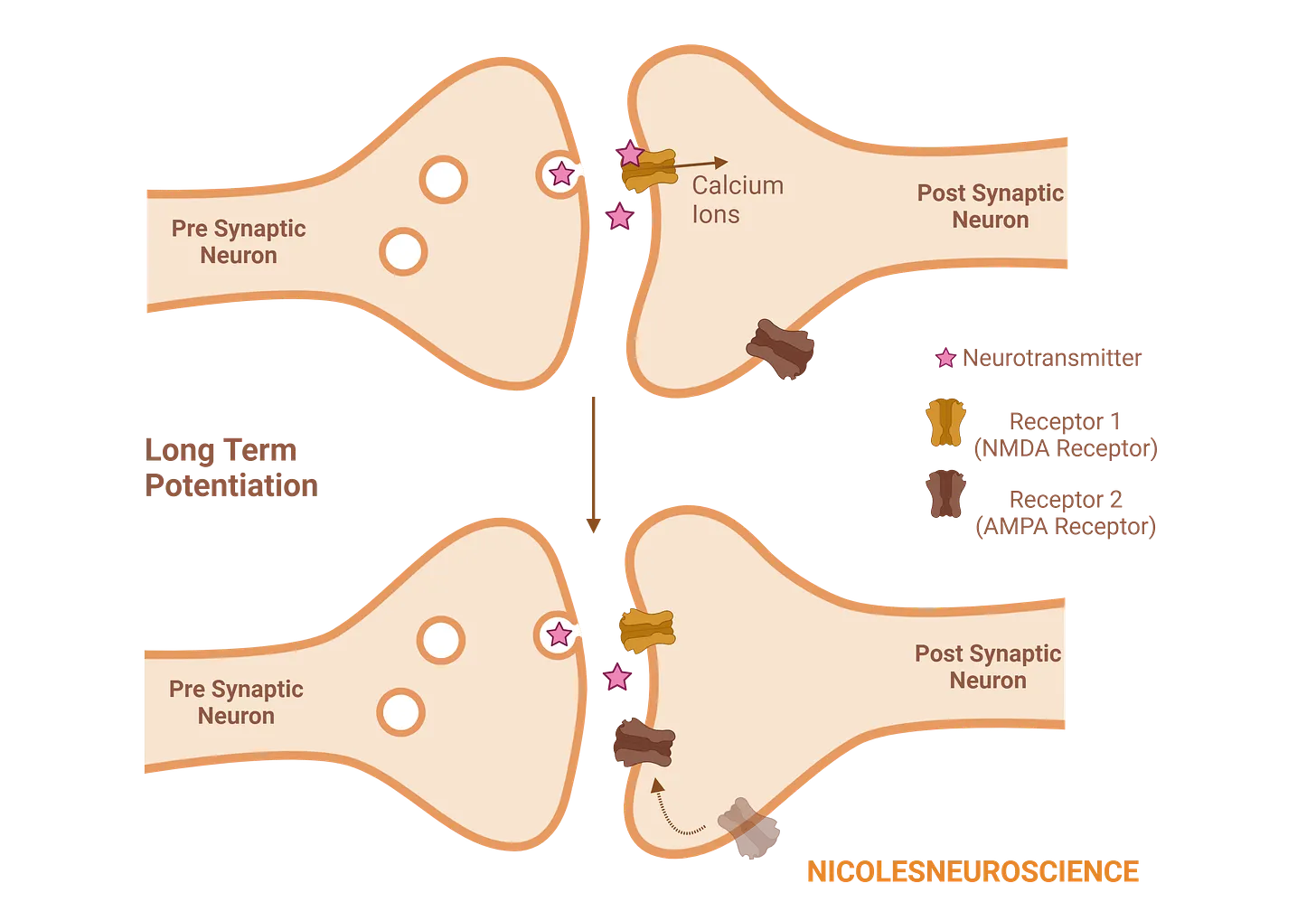
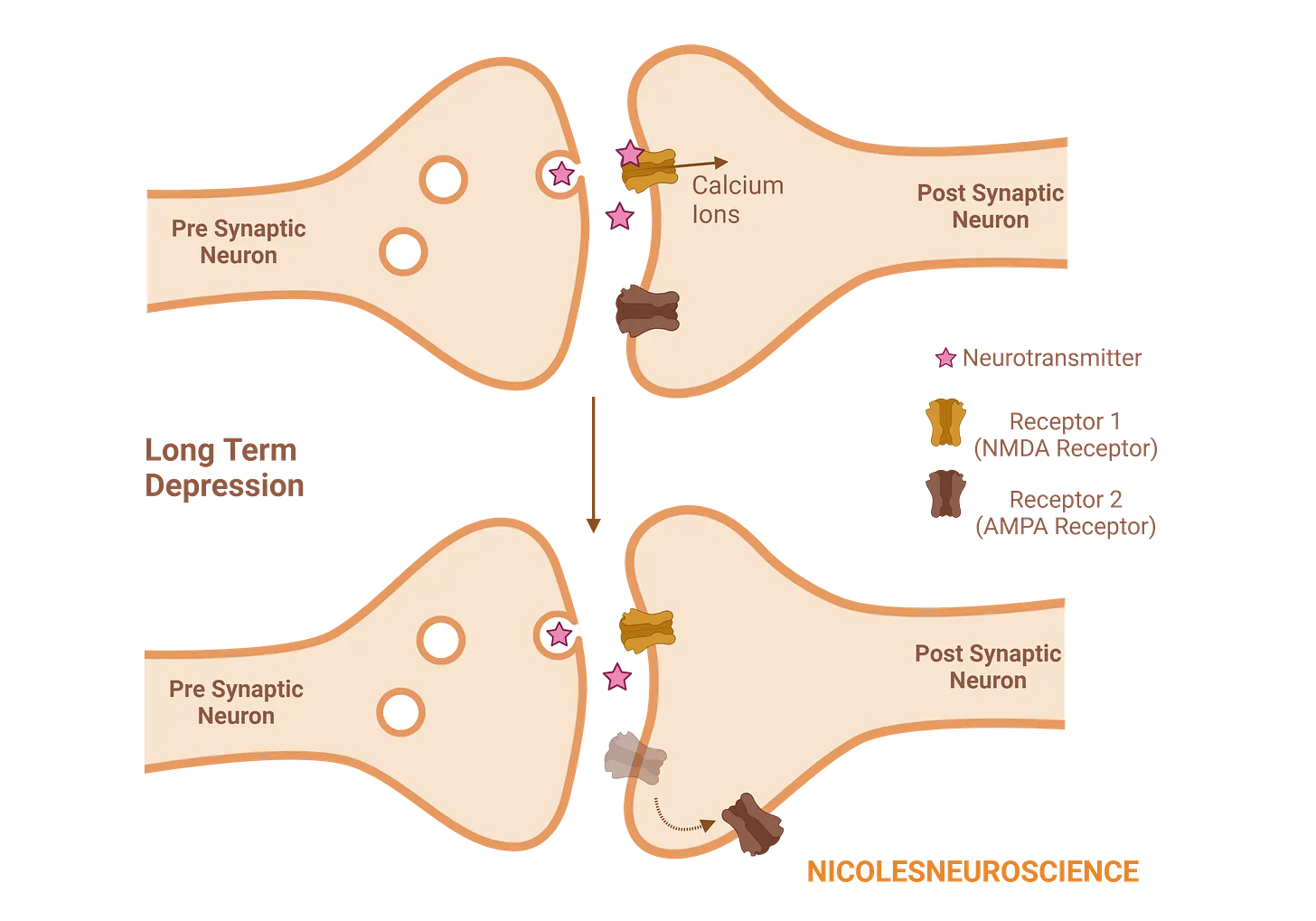
The ability for us to make new combinations in the brain is known as synaptic plasticity. Synaptic plasticity means that synapses can change, and there’s essentially two ways a synapse can change. Synapses can become stronger in response to repeated use (otherwise known as long-term potentiation; LTP)5. A ‘stronger’ synapse means that the pre-synaptic neuron is releasing more chemicals and the post-synaptic neuron is producing more receptors to accept those chemicals.
Alternatively, when synapses are not used as frequently, they can be weakened (otherwise known as long-term depression; LTD)6.
That’s what is sitting encapsulated under your skull. Trillions of little connections, constantly changing to adapt, that make you who you are. Somebody that nobody would ever be able to replicate. Somebody who is hopefully reading this now and realising their potential. The boundaries for how much you want to learn, and how mentally wealthy you could become are practically boundless.
The power of what we’re not thinking
So you might be wondering, if our brains are so vast, why can we only comprehend such a small amount at any given moment? That’s because conscious awareness accounts for roughly 5% of brain activity, while the remaining 95% operates beneath awareness, continuously processing information, linking memories, holding implicit information, regulating emotions, and shaping decisions.
But this isn’t an accident. Conscious awareness is energetically expensive. Our brains use 20% of the whole body’s metabolic energy, even when running 5% in conscious awareness. Our brains limit awareness to protect our energy, our Mental Currency.
While consciousness is narrow and selective, the subconscious brain is constantly operating beneath the surface, processing vast amounts of information in parallel. Here’s an example:
Have you ever walked into a perfume store and a random smell suddenly reminds you of a memory of when you were eight years old? Something that you haven’t thought of since then?
Well, just because you haven’t thought about it, doesn’t mean the memories aren’t there. Clearly they are! They’re in your subconscious; it’s just that we can’t retrieve every single one of them at any given point… yet they still exist.
And not only that, future memories may even have been built up upon that previous memory. Memories don’t sit in isolation like files in a cabinet. Each one becomes layered onto previous experiences, linked through shared sensory and emotional features.
So, the brain may have learned, without conscious awareness, that this particular sweet scent signals comfort, safety, or nostalgia. It’s also why sometimes, something gives you a particular feeling that you can’t put your finger on. It could be a subconscious memory stack communicating with you, but your conscious brain is just not able to pinpoint the reason why. Because even when we can’t consciously retrieve a memory, it continues to influence how new memories are formed and how we interpret the world.
This is the beauty of combinatorial explosions. Every new memory expands the number of possible interactions between ideas.
The power of what we are
The human brain has 86 billion neurons and trillions of synaptic connections; thus, our potential is incomprehensible to even try to quantify.
Which brings me to my next point, and that is that we all can be somebody who speaks seven languages, plays multiple instruments or has multiple degrees or all of the above combined if that’s what you want. Prodigies exist and nepotism gives immense advantages. But I think we’re all capable of genius in whatever way we want to achieve it.
We’re all shaped by our environment, and our available choices are not all the same. But, we can all make choices. Where do we give our energy to? Where are we spending our mental currency? Are we protecting our attention, our sleep, regulating our nervous systems?
Last week I said that neuroimaging studies2 show that the brain regions responsible for sustained attention show progressive decline in their activity the longer a demanding task continues. And it costs energy to switch from one task to another.
BUT we’re living in an attention economy, where your attention is a finite and valuable resource that everyone is after. This makes the noise louder and distractions more enticing. we have a finite amount of cognitive reserves, and if we’re constantly leaking attention to distraction, noise, and low-value demands, then we have less available resources for ourselves.
But distraction is a learned habit. And if attention can be trained into fragmentation, it can be trained into focus too.
Throughout my new book, Mental Currency, you’ll learn how to stop leaking your Mental Currency on things that don’t serve you, and how to deliberately redirect it toward what you truly care about
Your brain is infinite, but it’ll operate how it’s programmed. Learn how to program it for yourself.
Until Next Week,
Nic x
References
Kolb, B., & Whishaw, I. Q. (2003). Fundamentals of human neuropsychology (5th ed.). New York: Worth Publishers.
Handbook of combinatorics. Graham, 1995.
https://www.sciencedirect.com/science/article/pii/0959438894901015
This is fascinating! I look forward to reading your new book.